


Matthews’ Painting Introduces the POPP Standard: A Better Way to Protect Your Home During Painting Projects
September 8, 2026
When to Paint Your Home’s Exterior in Elkhart County
September 16, 2026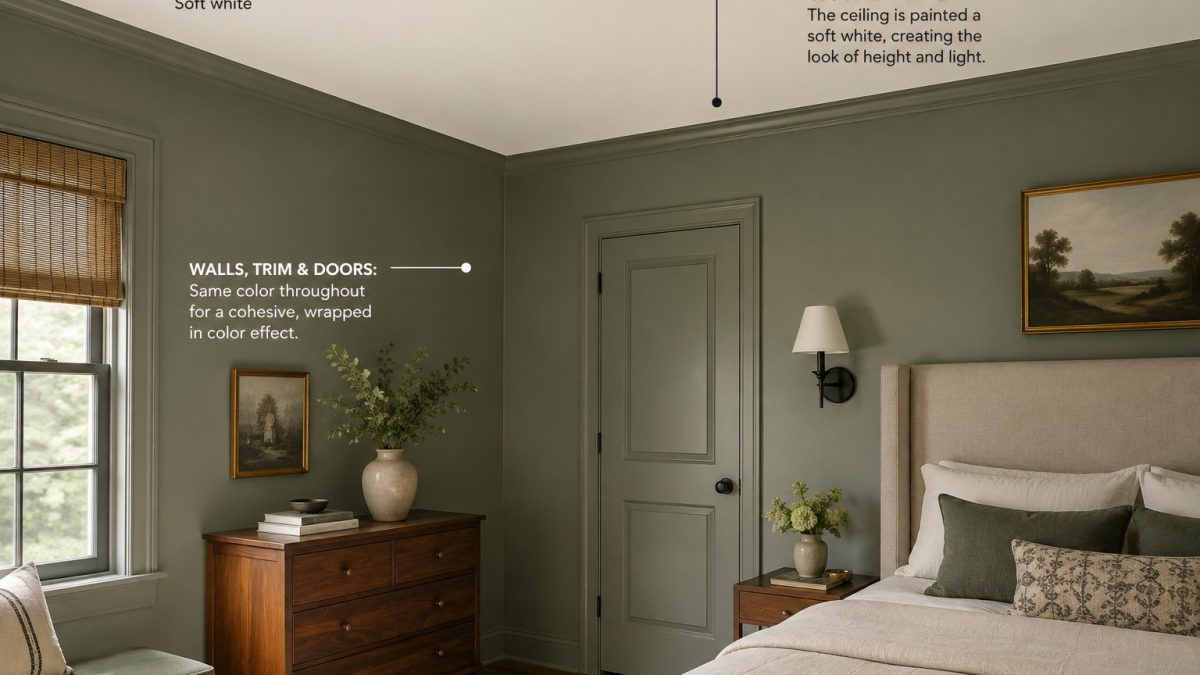
If you love the look of a room wrapped in color but aren’t quite ready to carry that color across the ceiling, there is a paint trend worth knowing: cloud capping.
Cloud capping takes some of what homeowners love about color drenching; the cohesive look, bold use of color, and ability to make architectural details part of the design—but leaves the ceiling lighter.
The result can be a room that feels colorful and finished without feeling quite as enclosed or saturated.
What Is Cloud Capping?
With cloud capping, the walls, trim, baseboards, doors, and other woodwork are typically painted in the same color or closely coordinated shades. Instead of continuing that color onto the ceiling, the ceiling is painted a softer white or off-white selected to complement the undertones of the primary color.
Cloud Capping vs. Color Drenching: What’s the Difference?
The biggest difference is the ceiling.
Color drenching generally carries one color across nearly every surface in the room, including the walls, trim, doors, and ceiling. It creates an immersive look where individual architectural elements visually blend together. It has been a popular trend because it creates impact that makes standard spaces feel like custom designer rooms.
Cloud capping uses a similar approach on the walls and woodwork but changes direction at the ceiling. The lighter ceiling provides some visual relief while the coordinated walls, doors, and trim maintain the cohesive effect. As a trend, Cloud capping is gaining popularity because it gives bold wall colors room to breathe while keeping the room light and airy.
Neither approach is necessarily better. They simply create different results.
A deep color carried across the ceiling can make a room feel dramatic, cozy, and enveloping. Keeping the ceiling light can preserve more of the openness homeowners are accustomed to while still allowing them to make a much stronger color statement than traditional white trim and colored walls.
Why Cloud Capping Paint Trend Can Work Especially Well in Smaller Rooms
It may seem counterintuitive to use more color in a small room, but cloud capping can be an interesting option for compact spaces.
Traditional paint schemes often create several visual breaks: one color on the walls, white or wood-stained baseboards, white or wood-stained window and door trim, white doors, and then another line where the walls meet the ceiling.
Painting the walls and woodwork together reduces some of those interruptions. Instead of outlining every door, window, and piece of trim, those elements become part of the overall room.
Then the lighter ceiling keeps the upper portion of the room from becoming completely saturated with color.
That combination can make cloud capping worth considering for bathrooms, offices, bedrooms, entryways, dining rooms, and other spaces where you want noticeable color without necessarily committing to a fully drenched room.
Don’t Treat the Ceiling White as an Afterthought When Painting
One of the most important decisions in a cloud-capped room is the color that gets the least attention: the ceiling.
Putting a stark, cool white above a warm green, muted terracotta, creamy neutral, or other nuanced wall color can create more contrast than you intended.
Instead, look at the undertones.
A carefully selected off-white can connect visually with the primary room color while still providing the lighter effect that makes cloud capping distinct.
And remember that paint colors can look very different depending on the room. Natural light, artificial lighting, flooring, furniture, and surrounding finishes can all affect how a color reads once it’s on the wall—or ceiling.
Take Cloud Capping Beyond Paint with our Carpentry Services
This trend can become even more interesting when there’s architecture for the color to highlight.
Picture cloud capping paired with picture-frame molding, wainscoting, board and batten, upgraded baseboards, or other wall and trim treatments. Painting those details along with the walls allows the texture and dimension to stand out without introducing another contrasting color.
Don’t already have those details in your home?
That’s where Matthews’ Painting can take the project beyond a simple color change. Our carpenters can add trim and wall treatments to help create or accentuate the architectural detail that makes a cloud-capped room stand out.
Instead of treating carpentry and painting as two separate projects, the room can be planned as one finished design—from adding the architectural elements to selecting how they’re incorporated into the paint scheme.
Is Cloud Capping Right for Your Home?
Cloud capping may be worth considering if you:
- Love color but aren’t sure about painting the ceiling a darker or more saturated shade.
- Want an alternative to the traditional colored-wall-and-white-trim combination.
- Like the look of color drenching but want to keep the room feeling lighter overhead.
- Have trim or architectural details you’d like to incorporate into the overall design.
- Want to add wall or trim treatments before painting to give a room more character.
Like any paint trend, cloud capping doesn’t have to be followed according to a rigid formula. The goal is to find a combination that works with your room, your lighting, your home’s architecture, and the way you want the space to feel.
Thinking About a New Look for an Interior Space?
As exterior painting season winds down in Northern Indiana, it’s a great time to start thinking about the rooms you spend the most time in.
Whether you’re considering cloud capping, color drenching, a new wall color, or adding custom trim and wall treatments before painting, Matthews’ Painting can help you plan the project from start to finish.
Ready to see what a little—or a lot—of color could do for your space? Contact Matthews’ Painting to schedule an interior painting estimate.